
The Mifflin–St Jeor equation
Daily calorie need is usually built in two steps. First you estimate basal metabolic rate (BMR) — energy used at complete rest. Then you multiply by an activity factor to get a rough total daily energy expenditure (TDEE).
This tool uses the Mifflin–St Jeor equation, published in 1990 in the American Journal of Clinical Nutrition (Mifflin MD, St Jeor ST, et al.). In many later comparisons it tracks measured resting energy in adults better than the older Harris–Benedict formulas. Weight is in kilograms, height in centimetres, age in years:
Men: BMR = 10 × weight + 6.25 × height − 5 × age + 5
Women: BMR = 10 × weight + 6.25 × height − 5 × age − 161
The same equation powers the standalone BMR calculator. This page only adds the activity multiplier.
Activity factors used here
| Level in the form | Factor | Typical day |
|---|---|---|
| Sedentary | 1.2 | Desk work, little planned exercise |
| Light | 1.375 | Exercise 1–3 days a week |
| Moderate | 1.55 | Exercise 3–5 days a week |
| Active | 1.725 | Hard exercise most days |
| Very hard training | 1.9 | Physical job or two-a-day training |
These multipliers are conventional planning factors, not laboratory measurements. A person who walks a lot at work may sit closer to “light” than the job title suggests.
Worked example
A 42-year-old woman, 168 cm, 72 kg:
BMR = 10×72 + 6.25×168 − 5×42 − 161 = 720 + 1,050 − 210 − 161 = 1,399 kcal.
At the moderate factor (1.55): 1,399 × 1.55 ≈ 2,170 kcal/day.
That is a planning midpoint. Illness, heat, menstrual cycle, and extra walking all move the real number. If you also want weight-for-height context, run the same measurements through the BMI calculator.
How this differs from Harris–Benedict
Harris and Benedict published resting-energy equations in 1918–1919. A 1984 revision by Roza and Shizgal is still widely copied on the web. Mifflin–St Jeor was derived from a later adult sample and, in several validation papers, has a smaller average error for non-athletic adults. No desk formula replaces indirect calorimetry in clinic.
Putting the number on a plate
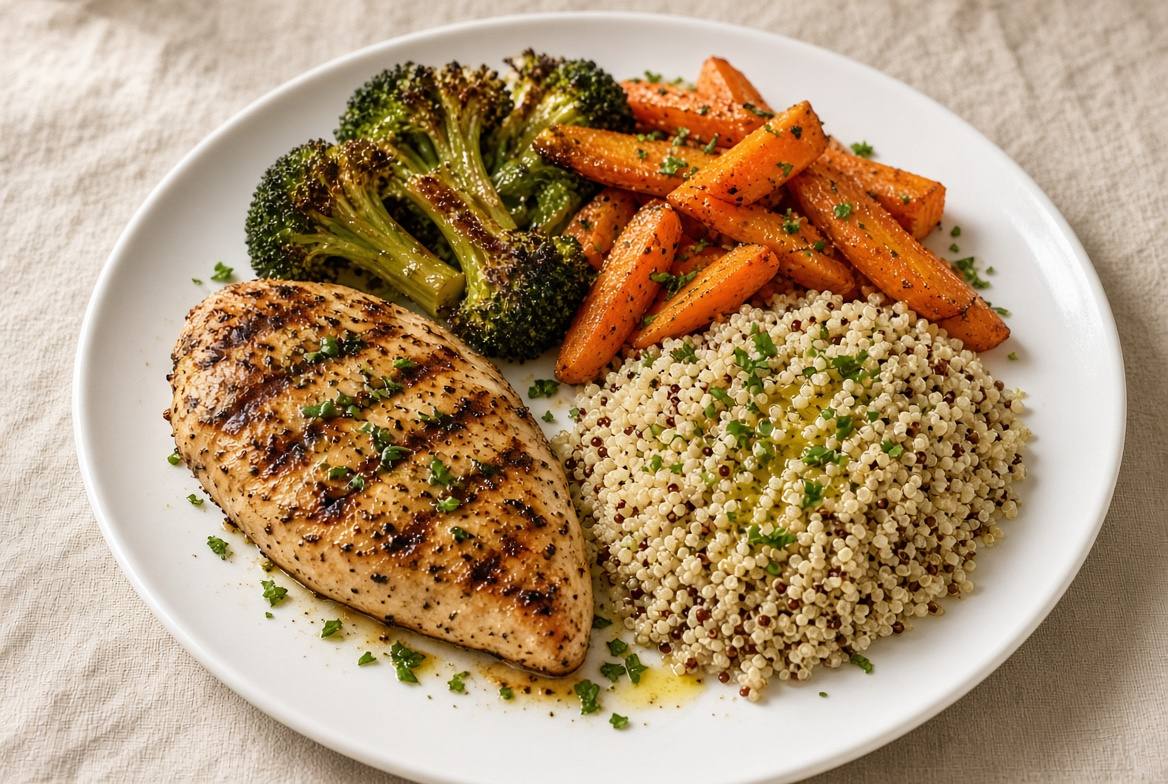
The calorie figure is only useful if meals can repeat. Use the meal framework for plate shape, the weeknight dinners for three concrete templates, and the anti-inflammatory foods list for grocery choices. A modest change is usually a few hundred calories around TDEE, not a crash target generated by a website.
Frequently asked
Should I eat my TDEE every day?
TDEE is an average. Training days, illness, and hormonal cycle can move it. Watch weekly trends, not one lunch.
Can I use this to lose weight?
The output estimates what you burn. Whether a deficit is appropriate is a clinical decision. This page does not assign a weekly loss rate.
Why does the form ask for sex?
Mifflin–St Jeor uses different constants for adult men and women. It is a population equation, not a statement about every body.
Is a food calorie the same as this kcal?
Yes in ordinary use. Nutrition labels in the US and many other countries use kilocalories, written as “Calories.”
Further reading: Mifflin et al., Am J Clin Nutr 1990; Wikipedia entries for “Basal metabolic rate” and “Harris–Benedict equation”; WHO and national healthy-weight pages for BMI context. We summarise published methods; we do not host those organisations.
What this tool will not do
It will not assign a weekly loss rate, store your entries, or adjust for thyroid disease, pregnancy, amputation, or high-level sport. If those apply, the equation is the wrong instrument. Use the number as a conversation starter with a clinician, then cook from the framework.