
Journal
Why crash diets fail
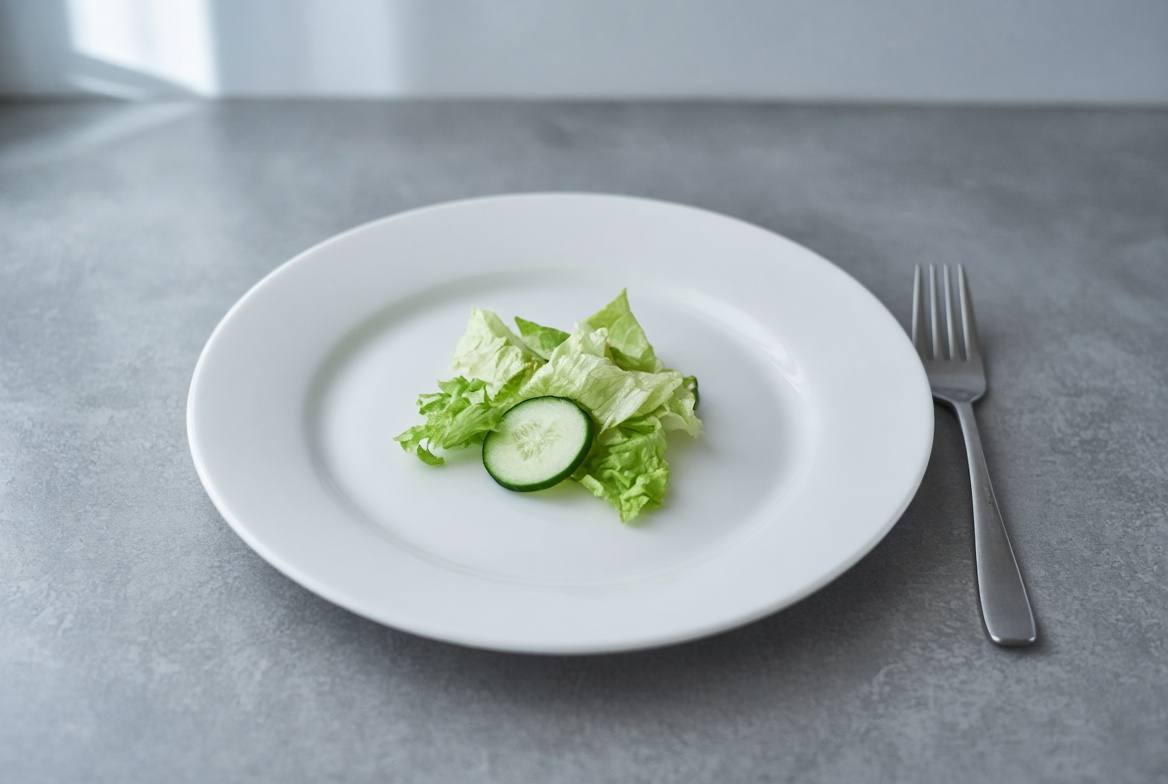
A crash diet is not “being good for a week.” It is eating far below a modest energy change — often far below what the calorie calculator would call a small deficit, and sometimes under the BMR figure itself. The scale moves quickly. A large share of that first drop is water and gut contents. Some of the rest is muscle. Hunger hormones rise. The packet you banned on Monday is back by Friday. That sequence is ordinary physiology, not a character flaw.
The plate in the photograph is the visual version of the same idea: a few leaves pretending to be dinner. Leaves are food. Leaves alone are not a week.
What actually falls off the scale
Glycogen in muscle and liver is stored with water. Cut carbohydrate hard and you lose that water in days. People call it “four kilograms of fat.” It is not. Fat loss at a sustainable pace is slow — often a fraction of a kilogram a week if it happens at all. A crash that prints a dramatic number teaches the wrong lesson: that theatre works and that ordinary food does not.
Lean tissue is expensive to keep. When energy intake collapses, the body is not obliged to spare muscle. Sit-to-stand gets harder. Walking minutes shrink. The BMI calculator may print a smaller ratio while the person in the room is weaker. That is why this site pairs size tools with the limits article and with mobility pages instead of celebrating a week of cucumber.
Hunger is not a motivation problem
Short, severe restriction raises the drive to eat. Sleep gets worse. Irritability rises. People then invent a moral story: they “lack discipline.” The more useful story is that a 900-calorie script was never a plan for an adult who still has a job, joints, and a kitchen. Protein at meals — see the protein page — and fibre from ordinary plants blunt that swing. A crash deletes both.
If the week after the crash is a binge, the crash caused the rebound as much as the biscuit did. Read extreme calorie cuts if the number you are aiming at is sitting on BMR. Read teas and wraps if a product is promising to do the week for you.
What a modest change looks like
Modest means a few hundred calories below estimated maintenance, not a thousand. It means plates from the meal framework: a palm of protein, plants, a starch you digest, a fat you can see. It means breakfasts you can repeat and dinners you can cook on a Tuesday. It means walking minutes that survive a sore knee — shorten the route; do not delete the habit. Use knee mobility or the back page when joints argue.
Check the calorie tool once to see a range. Do not recalculate every morning. Daily recalculation is how a useful number becomes a mood. Weight, if you use it, belongs on the metrics page as a weekly point, not as a verdict before coffee.
Social crashes and “resets”
January, a wedding, a beach photograph, a comment from a relative — these are how crashes get scheduled. A seven-day reset is still a crash with better branding. So is a cleanse that replaces dinner with liquid. Food is allowed to be unremarkable. Unremarkable food is how people still eat in March.
Households make this harder when one adult is dieting theatrically and another is cooking normal trays. Share the tray. Do not share the crash. Children are outside the scope of these adult tools; do not put a household on a 1,200-calorie script because an adult wanted a faster number.
Workdays, weekends and the Monday restart
Crashes love Mondays. The useful alternative is a Tuesday tray you already know how to cook. If Saturday was loud, Sunday breakfast is still eggs or yogurt — see repeatable breakfasts — not a punishment fast. Compensation fasting is how a weekend becomes an extreme cut by another name.
Clothes will not tell the truth after five days of water loss. A tape measured the same way, once a week, on daily metrics, is quieter than a wardrobe inquisition. If the tape and the BMI disagree, believe the limits article and the waist-to-height tool rather than the stricter of the two numbers.
When a clinician is the next step
Unplanned weight loss, fainting, a resting heart rate that is new and odd, a period that stops, or a relationship with food that is running the day — those are clinic questions. So is any history of an eating disorder. A calculator cannot sort that. The medical disclaimer is short on purpose.
Is a short crash harmless if I lift weights?
Lifting does not cancel a severe energy gap. You can still lose muscle and still rebound. Train, eat enough protein, use a modest deficit if a clinician agrees.
Why did my weight jump after I ate a normal meal?
Glycogen and water returning, plus food in the gut. That jump is not a week of fat.
Can I use BMI to decide how hard to cut?
No. BMI is a size snapshot. It does not set a safe intake. Use the calorie and BMR tools as context, then a person who knows your medicines and history.
What should I cook this week instead?
Open the framework and weeknight dinners. Build plates. Ignore the seven-day banner.
Are meal-replacement shakes a crash?
They can be, if they replace most of the day’s food at a very low energy level. A shake as one planned snack is a different product from a week of shakes.
Rapid early weight change on severe restriction is well described in nutrition texts as water and glycogen, with lean-mass risk when intake stays very low. This page is a plain-language reading, not a prescription.
If you close this tab with one decision, make it this: cook a plate with protein and plants tonight. Leave the empty-plate week on the photograph.