
Journal
Gentle hip mobility at home
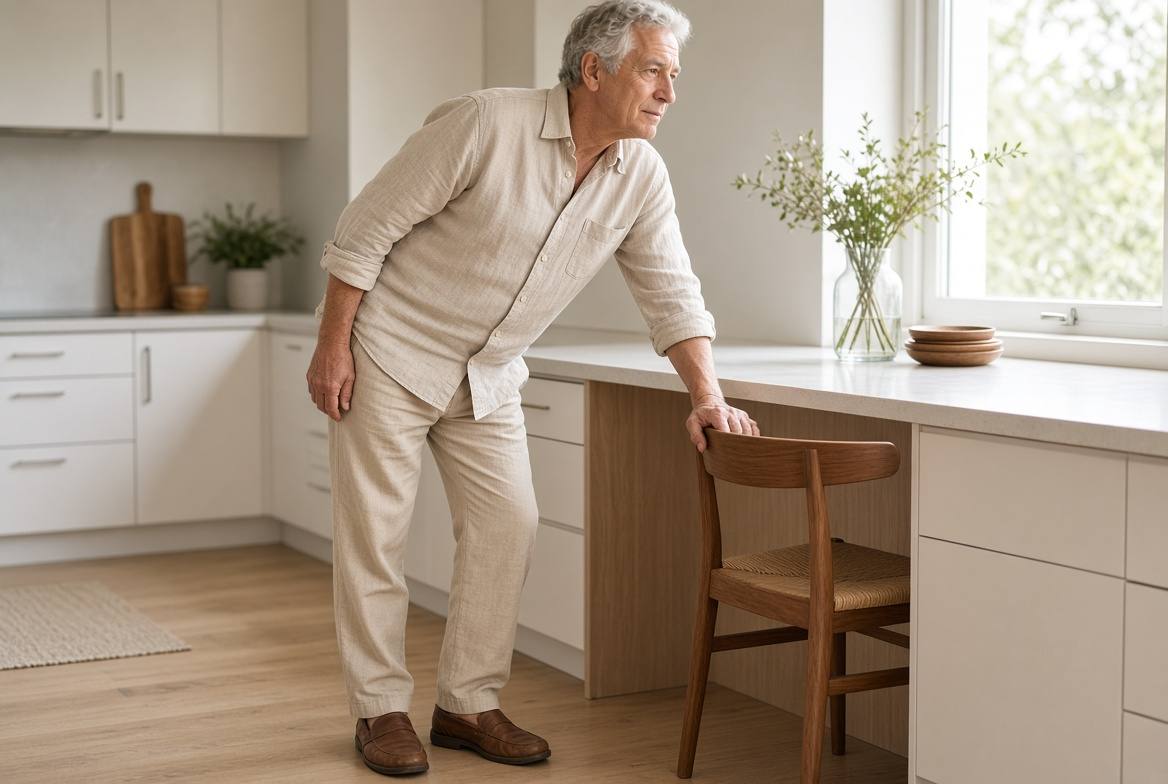
Stiff hips change how the lower back and the knees share load. People then stretch the wrong joint and wonder why the walk got louder. The photograph is the tone of this page: an adult, fully in view, hand on a kitchen chair, hips easing back into a hinge. No cliff. No band branded with a slogan.
If the knee is the louder joint, start with knee mobility. If the back is louder, start with the back page. Hips still belong in the week because they are how you stand up from the toilet at eighty.
Set-up that keeps you off the floor
A stable chair. Shoes or bare feet you will not slip in. Enough space to step sideways. Five to eight slow repetitions. Breathing you can hear. Pain that rises and stays risen is a stop, not a “good burn.” Heat, swelling, or a new limp the next morning means the dose was too high.
BMI is only load context. A larger body still deserves the same slow tempo. Use the BMI calculator as a snapshot and the limits article when the index and the joint disagree.
Five options, one chair
Sit-to-stand. Sit tall. Lean forward from the hips. Stand without using a swing of the arms if you can; use the arms if you need them. Sit slowly. This is also strength.
Hinge to the chair back. Hands on the back of the chair. Soft knees. Push the hips behind you as if closing a car door with your seat. Keep the back long. Return. This is the photograph.
Glute bridge. On your back if getting to the floor is safe and acceptable. Knees bent. Lift the hips a small distance. Lower. Skip the floor if dizziness or a shoulder problem makes lying down a bad bargain; stay with the chair work.
Hook-lying march. On your back, knees bent. Lift one foot a few centimetres. Lower. Switch. Small range.
Supported side steps. Hands on the counter. Step out and in. Keep the toes pointing forward. This doubles as quiet balance practice.
How often, and what not to add
Most days, a few minutes, beats a heroic Sunday. Do not add a deep squat challenge from a video the same week you started these. Do not stretch a hip flexor into a backbend because a reel told you to. Neck and shoulders have their own page; do not invent a full-body flow that leaves every joint irritated.
Walking minutes still count more than a perfect hinge. Shorten the route when the hip is noisy. Write the true minutes on daily metrics. Eat enough that the session is not performed in a crash; crash weeks make joints feel older. Protein at meals supports the strength piece; see the protein page.
Desks, cars and the hip that never extends
Hours of sitting leave the hip in a bent position. Standing up and walking to the kettle is already a drill. A lunch walk on flat ground is already a drill. You do not need a pigeon pose on a yoga mat to earn those minutes. If the first steps after sitting hurt, take them slower, use the chair hinge, then walk. Do not fold into a deep stretch from a cold slump.
Driving is the same problem in a different chair. Stop if the trip is long. Stand. Hinge twice. Then sit again. Pride that refuses a stop is how a hip becomes a back story.
When the hip is a medical object
A new limp after a fall in an older adult is urgent. Night pain that wakes you, unexplained weight loss with hip pain, or a joint that cannot rotate at all belongs in clinic. Replacement joints have their own rules from the surgical team. Follow those. This page is stiffness and ordinary ageing, not a post-operative protocol.
After a long sit — a three-minute sequence
Stand. Walk to a chair. Hinge five times. Sit-to-stand five times. Side-step along the counter four times each way. That is the whole sequence. It fits before a kettle boils. It does not require changing clothes. If any item hurts, drop it and keep the others.
People who add a twenty-minute video after this sequence often wake sorer, not wiser. Stop while the joint still feels usable. Tomorrow’s walk is part of the programme. So is dinner that is not a crash.
Uneven ground and the urge to “test” the hip
A hill, a wet path, a grandchild who wants to run — these will test the hip whether you scheduled it or not. Earn them after flat minutes feel ordinary. Do not schedule a hike as a mobility session the week you started chair hinges. Pride is how a useful page becomes a waiting room.
Should I feel this in the front of the thigh?
A little work in the thigh during sit-to-stand is normal. Sharp groin pain is a stop.
Can I do this after sitting at a desk all day?
Yes. Stand up first. Walk to the kettle. Then hinge. Do not start from a cold slump into a deep stretch.
Is a foam roller required?
No. A chair is enough. Rolling a sore hip for twenty minutes is not this programme.
What if I cannot get to the floor?
Skip the floor options. Chair hinges, sit-to-stand and side steps are the programme.
Will this fix my back?
It may help the back share load. It is not a diagnosis and not a promise. Use the back page alongside this one.
Chair-based hip hinges, sit-to-stand and side-step patterns appear in many fall-prevention and joint-sparing home programmes. Stop rules matter more than variety.
Put the chair in the kitchen. Do the hinge while the kettle boils. That is a week.