
Journal
Balance practice you can do at the counter
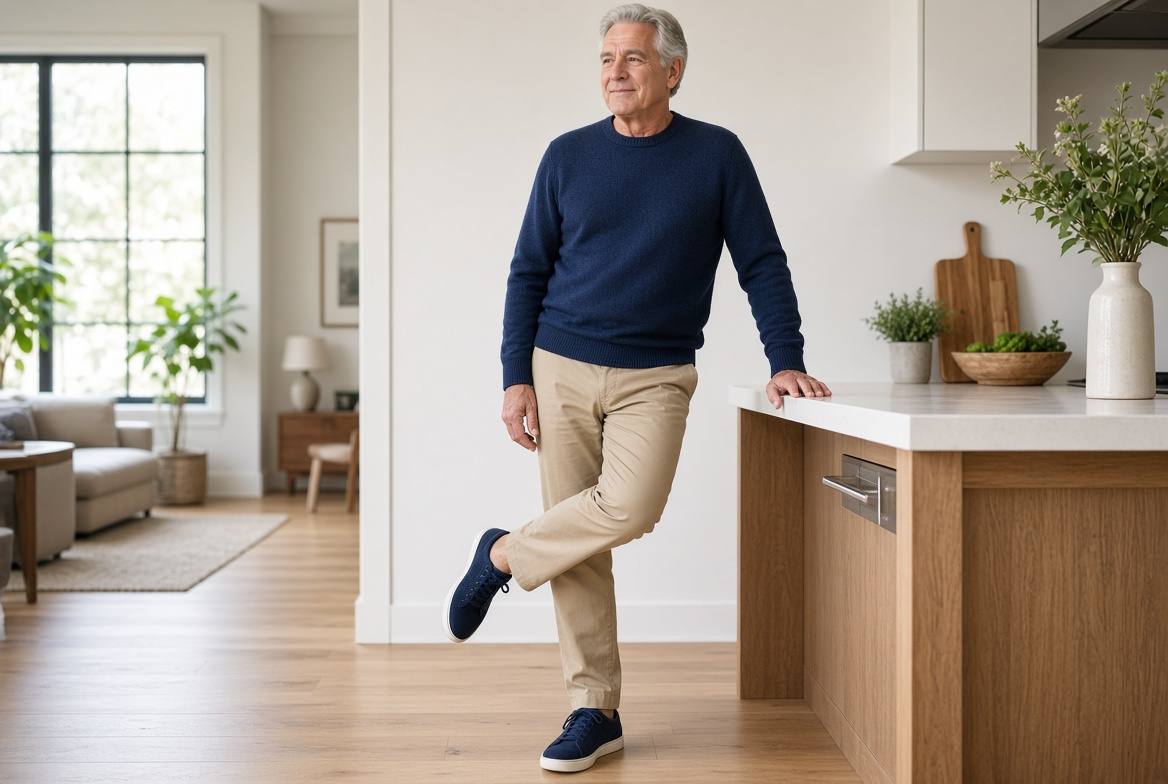
Balance is a skill that shrinks when it is not used, especially after a quiet winter or a week of staying in a chair because a joint complained. The useful version at home is dull: shoes or stable bare feet, a kitchen counter, one task at a time. The photograph is that scene — an adult, fully visible, close enough to grab wood.
Hips and ankles share the work. If the hip is too stiff to step, use hip mobility first. If the knee is the reason you stopped walking, use the knee page and shorten the walk rather than inventing a slackline.
Set-up
Clear the floor of a rug that slides. Keep a chair behind you if you like. Do this when you are not rushing to a kettle that is already screaming. Two or three minutes is a session. Quality is a pause you can control, not a wobble you barely survive.
Medicines that lower blood pressure, a new inner-ear problem, and alcohol the night before all change the drill. So does standing up fast after sitting. If the room moves, sit. Read home blood pressure if dizziness is part of a larger story, and take that story to clinic.
Drills you can grab for
Feet together, hands on the counter. Stand. Lighten the fingers. Count to ten. Step out. That is day one.
Semi-tandem. One foot slightly ahead of the other, still near the counter. Hold. Switch. Do not progress to a tight rope on day one.
Single-leg stand with two fingertips. Only if the first two options feel ordinary. The raised foot stays close to the floor so you can put it down. Ten seconds is enough.
Weight shift side to side. Both feet down. Move the centre of you toward one foot and back. Keep the eyes on a point at head height, not on your shoes.
Close eyes only when a person is present and the counter is under your hands. Closed-eye work is how people discover an inner-ear problem the hard way.
Walking is still the main programme
A daily walk on even ground does more for later-life balance than a perfect kitchen pose. Write minutes, not steps theatre, on daily metrics. Uneven paths come after flat paths feel ordinary. Hills are optional.
Strength is part of balance. Sit-to-stand from the hip page is allowed here. Eating enough to keep muscle is allowed here. A crash that deletes dinner will not make you more stable; see crash diets and keep protein on the plate from the protein page.
Shoes, night trips and pride
Shoes you can feel the floor through beat a thick unstable sole for this drill. Night trips to the bathroom are a common falls scene. A light and an uncluttered path help more than a new gadget. Pride that refuses the counter is how a practice session becomes an injury. Use the counter.
Glasses that are only for reading should not be the glasses you walk to the kitchen in at 01:00. Pets that wind around your feet are a balance problem with fur. None of that is a joke when the floor is hard.
Progress without a circus
When feet-together feels dull, move to semi-tandem. When that is dull, try the fingertip single-leg stand. If any step feels like a stunt, go back one step. A calendar streak is not the goal. Not falling is the goal. Wearables that score “balance” are optional commentary; see what a watch cannot say.
Practice that fits a kettle
While the water heats: feet together, hands on the counter, ten quiet seconds. Semi-tandem if that felt dull yesterday. Then pour the tea and stop. That pairing is how a skill survives a busy house. A separate “balance appointment” in a spare room is how the skill dies after four days.
If another adult in the house mocks the counter work, practise when they are out, or ask them to stand nearby instead of commenting. A spotter is useful. A critic is not.
Ice, wet floors and outdoor steps
Home practice does not make ice safe. It does not make a wet bathroom tile safe. Handrails and wiping the floor are still the method. Outdoor steps with no rail are a planning problem: use a different door, carry less, take the rail that exists. The drill in the kitchen is for the kitchen and for calmer walking, not for a dare on a frosty path.
How many days a week?
Most days, briefly. A missed day is not a restart.
Can I stand on a cushion?
Not at first. Soft surfaces raise the challenge before the skill exists. Earn the floor first.
What if I feel safer holding on hard?
Hold on. Lighten the fingers later. A grip is not a failure.
Does a wearable track balance?
Some try. None replace a counter and a walk.
I already fell this year. Can I use this page?
After a clinician has seen you and cleared home practice. Then use the counter. Do not invent a harder drill to “catch up.”
Counter-supported stance progressions are standard in community fall-prevention teaching. Supervision rules after a recent fall belong to the clinician who saw you.
Stand by the sink. Lighten the fingers. Put the foot down the moment the wobble gets interesting.